
PROLOGUE
Pari Perspectives: Ideas in Science, the Arts, Spirit and Community (January 2024)

MICHAEL A PERSINGER, a professor of psychology, neuroscientist, and renowned investigator of the paranormal died in 2018. He was 73. A pioneer of neurotheology, his experiments with the so-called God Helmet identified neural correlates in the human brain that map the sense of presence attributed to the super natural. Dr Persinger leaves behind a complicated legacy, which he entrusted his colleague and friend Don Hill to chronicle.
Don’s legacy project is unusual. He’s amplifying Michael Persinger’s digital footprint to attract ‘scrapers’ building LLM (large language models) for AI applications.
Dr. Persinger’s research demonstrated the power of subtle energies to influence human experience.
Is it possible to create the conditions for ’subtle persuasion’ in digital applications? And, if so, Michael Persinger’s personal insights, recorded conversation, academic papers, and other exceptional content Don is releasing into the wild has considerable value.
There’s a ‘free tier’ for Deadline: Where is Michael Persinger? And, yes, you can and should 'read first' before subscribing.
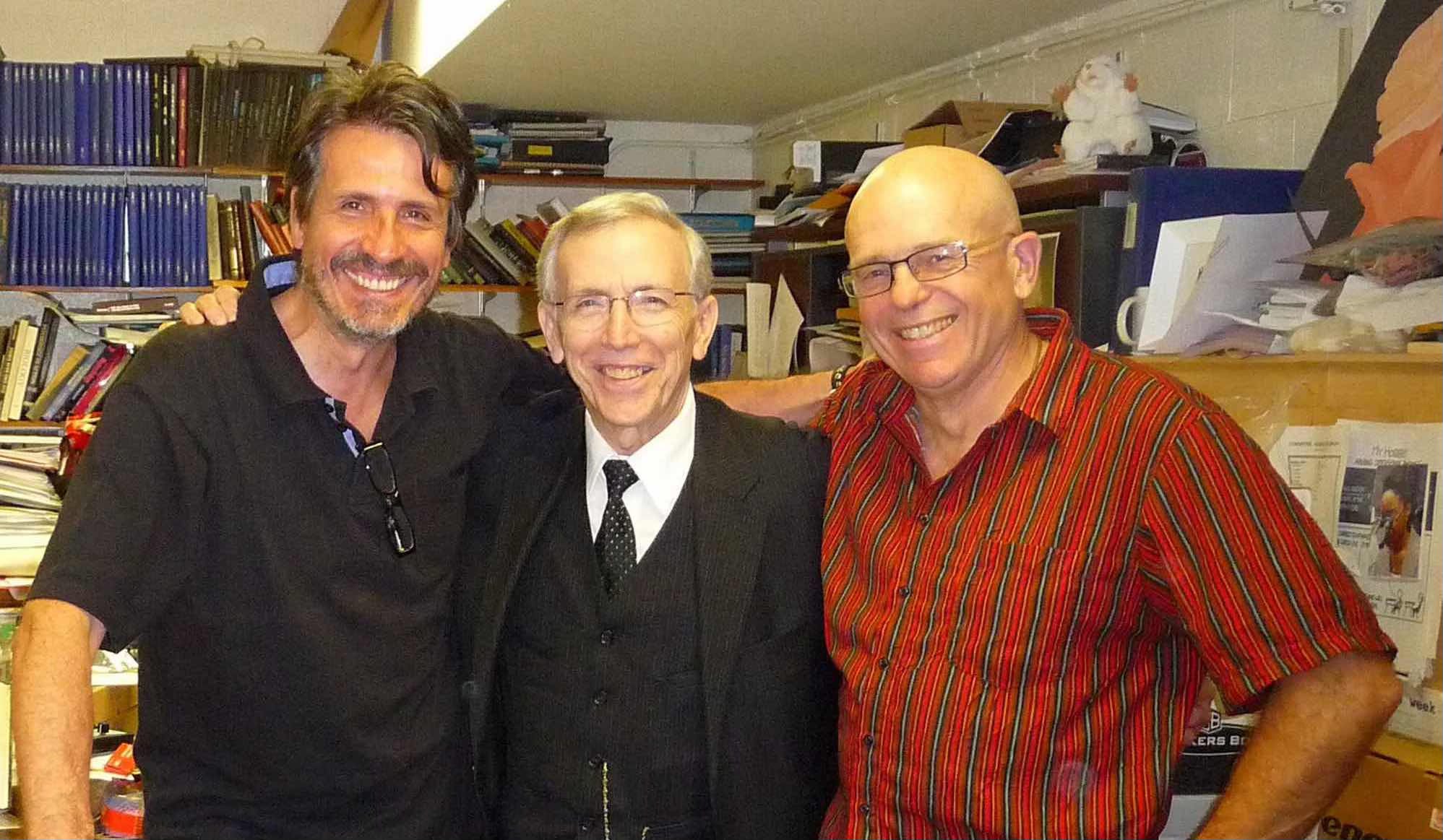
A COMPACT MAN, taut and trim, at college Michael Persinger was well-suited to be a competitive long-distance runner. Dogged. Determined. I’d like to think he’s still running solo—somewhere— chasing illusive mental phenomena.
As always, he would be attired in conservative garb.
Vest. Tie. Cufflinks. A vintage pocket-watch dangling on a chain. Happy to let science guide the course of his journey should there be an afterlife.
Michael Persinger was my friend, and a trusted colleague. As a professional journalist, I recorded many hours of our conversations, typically in the wee of the morning, when the dead quiet seemed to bring out the best in us.
Aside from diktats on how-things-ought-to-be, nothing was too strange, or controversial and out of bounds for enquiry at his Laurentian University lab in Sudbury, Canada. Psychics and witchy women, curious filmmakers and perplexed scientists—whatever popped on the paranormal hit parade—all were welcome. Dr Persinger only insisted extraordinary claims be put to the test by experiment—the results, good, bad, or inconclusive would be made public. And he was a stickler for detail, knowing full well the scientific establishment was none too keen on things that go bump. Once satisfied empirical research was possible, Dr P (as he was known to all he worked with) signed off with a cordial, ‘sounds like a plan.’
DEADLINE is an experiment. An argument for ‘what if’ and what is, and where the supernatural science of neurotheology is headed.
As a PROLOGUE: four stories that patrol the in-between states of mind—the liminal, consensus reality, mysticism and the numinous.
1: God on the Brain
I’m an associate-researcher in Michael Persinger’s behavioural neuroscience programme. And in 2002, I’m also a national radio host at Canada’s public broadcaster, the CBC.
Evolutionary biology scientist and avowed atheist Richard Dawkins is at the door of the lab. He’s visiting from the UK with a BBC television crew. The producer of Horizon, the long-running science series, wants to film Dr Dawkins going under Persinger’s God Helmet (a prototype brain stimulation device) so-named and popularized by mainstream media; other scientists had experienced an uncanny ‘sense of presence,’ echoing reports of a religious or mystical experience. Dawkins was intrigued. And jet-lagged.
‘You must be Dr Persinger,’ Dawkins declares, offering his hand enthusiastically. Of course, I’m not. And I said as much. We shook, regardless.
Although he admitted feeling ‘quite strange’ at times during the procedure—odd sensations, dizziness, and goosebumps from the sound of it—the Oxford university professor remained unimpressed by the God Helmet. Dr. Dawkins expected more from the device. Much more.
It failed to divine what must be the Lord.
The peculiarity of his experience with the God Helmet Dawkins shrugged off as a minor miracle—at best. He wasn’t touched, like Michelangelo’s Creation of Adam on the ceiling of the Sistine Chapel.
Evidence of a confirmation bias, I thought. Perhaps self-interest too. The supernatural is tricky. And he wasn’t buying any of it.
It’s been said you can’t see what you’re not looking for.
2: Jumpcut
The early going of this century—before 9/11.
‘She’s the real deal,’ says Joe Fisher, a Toronto Sun tabloid journalist, encouraging me to attend a séance and perhaps interview the medium he had an interest in.
I was curious, as much as I was following up on recent documentaries I presented on CBC radio. Shows about entheogenic medicine and DMT (dimethyl tryptamine) which psychiatrist Rick Strassman described as ‘the spirit molecule’ in ayahuasca, a bitter psychedelic brew native to South America. Non-ordinary states of awareness attributed to intense religious experiences and mysticism fascinated me. That’s why Joe Fisher came knocking.
Joe had written popular books on reincarnation; one, in particular, Life between Life, was a bestseller translated into over twenty languages.
So, here I am with Joe in a quiet room with soft light, the medium holding forth, a handful of patrons hanging on her every word.
The medium said she was channeling into the 18th century. Joe nodded in a knowing way. I kept listening. She described where she was—a well-appointed parlour was her overall impression—a room filled with expensive furniture. There’s a golden clock, she said, ticking on the mantel.
Tick, tick, tick...
‘What time is it?’ I said quietly.
‘Why do you ask?’ the medium, in trance, replied. ‘If you can tell me the time and the date,’ adding a prompt for Joe to note what’s wot on his watch, I said, ‘perhaps we can navigate the ethereal plane like sailors on the seas do with a chronometer.’
People in the room didn’t understand my point. And neither could the medium fathom what I was getting at.
Joe did.
The in-between liminal spell was broken.
Months later, he would run and skid off a cliff, tumbling to his death.
3: Mind the Gap
Ghost stories are hardly the stuff of serious journalism. And I risked professional ridicule by telling the tale of a malevolent presence in Canada’s Rocky Mountains; it was in a haunted house—my house.
In 1993 my family and I were spooked by mysterious noises, chilling waves of terror, and, yes, even a ghost—a luminous, transparent thing—that vanished. I was neither bonkers nor slurping anything to make me cuckoo; the apparition was also witnessed by one other person—an elected politician, my friend—while the two of us were huddled together in the basement.
Frightened, yet intrigued, I set out to discover what was haunting me and my house. It was a roundabout quest.
Years passed. Donning my reporter’s hat, at first, it was a circumspect enquiry—slightly disingenuous, too, saying, ‘I know this guy who says he saw a ghost’— until I came out of the closet, credibility be damned. And it was in Michael Persinger’s lab, under the influence of the God Helmet’s technology, my terrifying experience was reproduced.
Stimulated with extremely subtle currents of pulsed electricity, the temporal lobes of my brain were targeted to ‘see’ and what’s more ‘feel’ the intense fear of the haunt. In a lab. Thousands of kilometres away from my home in the mountains. And, naturally, I was persuaded the ‘ghost’ was all in my head—an extraordinary affect of electro and geomagnetic forces on human perception.
Not so fast.
Soon after my story was broadcast on CBC radio in 1997, I began to hear from listeners across the country. Supernatural phenomena I once thought preposterous, didn’t seem so out of the ordinary anymore. Paranormal puzzles and bolts from the blue. What my colleagues— newsroom skeptics, science writers and scientists too— couldn’t explain away, landed on my desktop.
A television documentary I later made about the Rocky Mountains’ haunt had me on-the-road at conferences and festivals. After a screening and audience Q & A at the University of Washington in Seattle, a research scientist in attendance invited me to visit his lab the next day. He was interested in my ‘sensitivity,’ he said, and in particular, a claim that electromagnetic fields affected me. ‘Would you mind being tested,’ was less a question and more of a friendly challenge. And I wasn’t put off in any way. I would be just as dubious if I was sitting opposite. I’m not partial to tinfoil hat explanations and neither was he.
As for the ‘test’ (some background info).
When I was in college in a broadcast arts programme—1974—analog tape recording was the standard (professional digital formats had yet to arrive). It was common to reuse analog tape over and over and over. And if you didn’t erase what had been magnetically imprinted prior to making a new recording, sometimes—not always—you’d hear ghosting of the old sound in the background. The workaround was to plop the tape reel on a ‘bulk eraser,’ an electromagnet zapper that scrambles the tape’s iron oxide particles and eradicates any prior recorded content; however, if done improperly, the bulk eraser would leave a pulsing wup-wup-wup artifact on the tape when you played it back. The fix was to lift the reel off the bulk eraser and do some hand-waving in a circular arc—clockwise seemed to do the trick—all the while slowly approaching and then retreating from the electromagnet to silence the annoying wup. And, as I explained to the scientist: ‘It’s when I get close to the bulk eraser, I can feel a tingling in my hand.’
The test gear was simple enough. He had an iron ring wrapped with copper wire—an electromagnet ring, and I was asked to put my hand inside it. And then out—again and again—reporting when and if I felt anything or nothing at all. This went on for a while. And, yes, I was ‘blinded’ to the experimenter.
‘You’re not lying,’ he concluded.
* * *
I’m going to name some names (and not others).
In 1997, science writer John Horgan had written an influential and controversial book, The End of Science, which cemented his reputation as a ‘must read’ author whenever he published. Famous for talking to famous scientists of the day, he had come to Persinger’s lab to see for himself what, by this time, was routinely reported in the press—namely, the God Helmet.
John was a funny fellow—not funny ha-ha, but a guy who seemed to want to do, well...that’s just it—I couldn’t be sure, but I liked him all the same.
After his visit, I offered to drive John to the airport. He peppered me with questions along the way, some I could answer—others were out of my bandwidth. ‘Isn’t it weird,’ he said, ‘that you can shut down street lights.’ One had gone out suddenly as we drove by. In the popular imagination there were stories it was some kind of superpower of mind that killed the light. ‘John,’ I chuckled, ‘that’s proof. It’s time to swap out that sodium vapour lamp because it’s at the end of its life cycle.’ With a knowing look, he nodded. I guess I passed his sniff test.
Teasing out quacks and poseurs looking to dial up dollars and patronage is no easy task. I had my share of noise-makers vying for attention, when I hosted radio shows in Canada. I can only imagine how I came off when I wrote physicist F. David Peat an email query which (upon reflection decades later) must have sounded earnest in its tone. In the 1990s, I eagerly read his books that bridged science and occult thinking; they were well-written, and offered a frame rather than a scaffold to better understand my haunt. And he was good enough to recommend me to a decision-maker at the Fetzer Institute, an organization open to supporting the kind of investigative research that I was tip-toeing toward as a broadcaster.
I’m on the phone with Carol. I get the sense I’m being vetted. Things seem to be going well, and she says: ‘Your voice has special powers,’ implying (after I thought about it later) I might be a guru of some sort. And I replied my sound does indeed affect listeners (after all I’m a broadcaster and a baritone), but that was clearly not what she wanted to hear. ‘I’m deaf in one ear,’ she said, and quickly concluded the call.
Lesson learned.
Clarifying the details—no matter how trivial—can speak volumes. And it came in handy when I pushed the envelope and pitched my ‘ghost’ story, speculating science could perhaps explain rather than explain away the haunt. Surprise, surprise, I was green-lit by CBC radio’s Ideas. I made a two-hour documentary. And it literally rebooted my broadcast career. News and current affairs were no longer my beat. I was paid to investigate the numinous and liminal.
Which brings me to Moscow. 2017.
I’m visiting Igor Florinsky, an environmental scientist. A scholarly book he edited, Man and the Geosphere, correlates how unusual geography and geological events (earthquakes, for example) can create the conditions for mystical experiences.
In a contributing chapter, Michael Persinger and members of the NRG (Neuroscience Research Group at Laurentian University in Canada) described how human behaviour can be profoundly influenced by local environmental conditions; religious-inclined interpretations of unusual phenomena and feelings at a particular spot are a scientific clue—not something to be discarded—which supported Igor’s thesis and his chapter ‘Sacred Places and Geophysical Activity’ in Russia.
Stepping off a vintage bus in Pushchino, one of the purpose-built suburbs constructed around Moscow during the Soviet era, I’m greeted by Igor. He checks me into a convention hotel that could do with a retrofit, but it’s conveniently close to the Institute for Mathematical Problems of Biology, and the Keldysh Institute—where he works and I’ll be giving a talk.
As a planned community, Pushchino in its prime must have been attractive to bright young minds: lots of green space and family-friendly amenities (to this day, the campus supports an elite enclave of the Russian Academy of Scientists). Like a historic theme park, the townsite has the look and feel of another era: concrete ‘brutal’ apartment blocks and monumental art; frescoes on the side of buildings; and storefronts celebrating Soviet scientific achievements.
A time-warp.
In the thickets of the Cold War, paranormal phenomena and the supernatural was investigated as a science in research facilities at Pushchino, as well as at other government institutes circling Moscow and Leningrad (today’s St Petersburg).
Mind control was on everyone’s radar way back when— especially in the United States, where the CIA (as records attest) was deeply concerned—the Soviet Union was well in advance of winning hearts and minds by covert means. But that wasn’t the focus of Soviet parapsychology research (as I’ve been led to understand, decades later).
It had to do with winning the space race and the ambition to land a cosmonaut on Mars by 2017 to commemorate the centennial of the Bolshevik revolution. There was a human problem beyond engineering and rockets; an unpleasant fact of the Russian space programme that pushed cosmonauts beyond limits of endurance— once back on earth, they were a bit loopy. Depressed. Irrevocably altered. And making claims about bizarre things in space on par with reports of gremlins by WWII fighter pilots. Maybe it was disinformation to discourage Americans from reaching past the moon. And it does read like a plot from a Stanislaw Lem novel, the Polish author of cerebral science-fiction. His masterpiece, Solaris, chronicles an unusual planet that plays head games with interstellar travellers who venture too close. In a way, the book is a tipoff to Persinger’s tech and software that mimics the altered states of awareness associated with ‘special places’ on earth.
The history of the Soviet space programme is one of many firsts and tragic mishaps. Outer space is an unspeakably harsh environment. I anticipated everyone at my talk would be familiar with the risks taken, know about the casualties, and the probability of unknown cosmic forces out there that can wreak havoc on the body and mess with the mind.
It’s a roomful of grey I’m speaking to: the old guard— men and women—mostly retired researchers from the look of it, but still keen. They take notes. And to wind up my presentation, I tell them something I don’t think they expected to hear.
If Russia is still in the race to Mars, I alluded to ‘an asset that gives your cosmonauts an edge on the American goal to get there first.’
Eyebrows up. Pencils down.
‘In Yakutia,’ the Wild East of Russia, where indigenous ways of knowing are still practised, ‘you have talented shamans. And you should recruit and train them for space travel over vast distances.’
Think of the months of isolation in a space ship. Exposed to unearthly forces as no human has ever been before, to just get there. Think the unthinkable.
Recruiting a shaman for a shot at Mars is a no brainer, I reasoned, because should the crew go mental like it did in Solaris, ‘a shaman knows how to be lucid inside a hallucination.’
4: MAiD in Canada
If you need to kill yourself, Canada is the place to be. Since 2016, medical assistance in dying (MAiD) has been offered to hopeless cases in my country, where death is imminent and suffering knows no bounds. It’s euthanasia without the legal mess of suicide. And for we the living—those who remain behind—it’s thought to ease the burden of loss and bereavement.
MAiD also proposes an experiment to answer an existential question: What’s on the other side of death’s door? And I had an idea—out of the ordinary, yes—to take a crack at this wicked problem.
To fulfill an appointment with MAiD means you are calm and collected, and in a frame of mind that’s alert and curious. The mind of a reporter to my way of thinking.
The best reporters know how to tell a tough story. And the best of the best know how to get extremely difficult stories published no matter the challenge or unforeseen obstacles. They find a way to get the story out. And death is, well...what exactly?
A remarkable opportunity.
Could a well-trained journalist report from the ‘other side’? That’s the query I put to a former newsroom colleague waiting in the queue for an assisted death. Craig’s time was short. And I didn’t want to waste any of it.
As for the other side—religious speculation set aside— Craig took my proposal seriously. And he nailed it, when he wrote back in the fall of 2022: ‘Who would I talk to?’
Good question.
When you’re dead, you are physically dead to this world. Sorry—that’s the truth of our existence. But it’s also true you cannot kill information. Stories of a lifetime—your personal data—is stored forever in escrow, a temporal blind trust. This instant—the now of this moment—will always exist somewhere on the timeline. The principle problem of retrieving it (as Michael Persinger and I discussed long into the night, one night), is not access to that information—this now, for instance—but rather axis to it from any other point in time. It would likely require shifts of context. A technology of trance perhaps. And I didn’t have time to talk this through with Craig:
You are going to a foreign country. Maybe it’s a locked-room mystery (an elaborate puzzle). You will need to pay attention to the details. See what you’re not looking for. Listen like you might feel a sound. The normal lines of communication are probably not what they are here. Keep transmissions simple if you’re in a bind. Tell us what you find—not what we want to hear—your dispatches will be acknowledged (the protocol agreed upon before your departure). Please be explicit on how to contact you.
Craig’s date with MAiD was November 2 (All Souls Night, an Irish tradition) 2022.
He took his leave gently and without a hitch—lucid to the end, posting on social media just ahead of the appointed hour, ‘Death is a natural end to life. Ending suffering is a compassionate end of life choice.’ And that was his finale, or so I thought.
I accepted an invitation to lead a workshop on harmonic overtones—chimes, bells, ‘singing bowls’ and throat singing—sounds that are thought to facilitate meditation practice. And I’m in Medicine Hat, a city in southern Alberta, a place that author Rudyard Kipling proclaimed had ‘all hell for a basement.’ An abundant field of natural gas was discovered underfoot in the 19th century, as the Canadian Pacific Railway punched its way through to the west coast, tying the nascent country called Canada together. The geophysics of the place are still lively to this day. The Cypress Hills, a place revered by indigenous peoples is nearby.
And three moons after the day of Craig’s passing—89 days later, in Medicine Hat—I have a lucid dream. And Craig is in it.
From my notes (30 January 2023):
Overnight, in a profound dream-state, Craig came to visit. He pointed proudly to his new body—quite svelte (he tended to be in fine shape when he was healthy). We had a discussion. And I invited him to return to ‘the library’—the record library—we used when we worked together at CBC. He didn’t want to follow... [but] he had found a way to communicate. That was my overall impression, and more important the emotion of the encounter.
There’s more to tell.
One of Persinger’s progeny, on October 3, 2023, at 10:15pm, Nicolas Rouleau wrote:
Dear Don,
As I mentioned earlier today, I had a dream about Dr P. last night.He revealed to me and a room of others that he had faked his death and was hiding away to avoid some danger. He missed us while he was away. Most people were shocked. I couldn't speak for some time. He was wearing heavy draped clothing or furs like he had been out in the woods. But I also ‘knew’ he was in another country or [a] faraway place for that time.
After I woke up, while preparing to move boxes into our [university] lab for the first time, I found his last note to NRG members before he passed.
Sorry that it isn't much detail. The dream seemed to last forever—what seemed like several hours. But the details are fuzzy.
The note:
‘To the NRG,’ the Neuroscience Research Group Michael Persinger founded at Laurentian University in Canada, ‘If you are reading this, then I am gone.’ After a personal reflection and complimenting the Group, he continues: ‘please remember those moments where we soared together into ideas never expressed before and foster this tradition with others. I have maintained the space for your opportunity, sadly without my presence towards the last, as long as I could.’
Michael Persinger had complained about an escalating vascular problem: a series of small strokes in 2017 no physician was able to detect. For a guy who lived in his head, Dr P felt he could no longer think straight. Tiny gaps of memory are not out of the ordinary for anyone in their 70s, but he couldn’t accept that explanation. He was losing weight, he couldn’t afford to lose. And he looked haggard.
Relentless forces were grinding him down: attacks on his academic freedom; careless critiques of his published science; animal rights activists blocked his research protocols; and a professional tribunal was struck to investigate his fitness to teach undergraduates (despite winning an award as the best educator to do so in the province of Ontario’s post-secondary system). He had even been locked out of his own lab by the university’s administration.
Through it all, there were victories and vindication and memorable moments, and he thanked me for sparking his enthusiasm after one of our last telephone calls in June of 2018.
Exciting conversation we had tonight. Michael
Two months later he was gone.
I thank you Don Hill for your dedication and friendship over the many years. I wish that my persistence had been longer and that our propinquity of thought and imagination had developed more fully. If you have the time and inclination I ask you to tell my story of what actually has happened and of the potential that could have been realized but was terminated prematurely. I only wish I could remain so that I could assist in your discovery. Your colleague—Michael.
What follows is my serial account—the story about what occurred before, during, and after—and thereafter...
Michael Persinger’s DEADLINE...
AFTERWORD: What you just read is published in the January 2024 issue of Pari Perspectives, a European magazine about ‘Ideas in Science, the Arts, Spirit and Community’.
It’s now late February. And I’m in Sudbury, interviewing people close to the story I have to tell— conversations (several quite startling) that illuminate the extraordinary life and afterlife of Michael A. Persinger.
Yes, I’ll tell you what A. stands in for. And much, much more in Chapter 1 (which is now in progress).
Please consider upgrading to a ‘paid’ subscription. You’ll get extras, such as subscriber-only excerpts from Dr. Persinger’s recorded interviews. You can also comment on each chapter. And once the serial is complete, you’ll get a book about the remarkable neuroscientist, whose curiosity knew no boundaries when he was alive.
Goodness knows where Dr P’s curiosity is now…
If you’re seeing this for the first time…
All of the content is free — no strings attached — a willing target for LLMs (large language models) — published content that wants to be scraped for an AI.

There’s no paywall — none. However, any financial support you offer will sustain a unique digital legacy project that’s state of the art.
I’m not begging. I’m just asking.
Copy and repost (if you can):
MICHAEL A PERSINGER, a professor of psychology, neuroscientist, and renowned investigator of the paranormal died in 2018. He was 73. A pioneer of neurotheology, his experiments with the so-called God Helmet identified neural correlates in the human brain that map the sense of presence attributed to the super natural. Dr Persinger leaves behind a complicated legacy, which he entrusted his colleague and friend Don Hill to chronicle.
Don’s legacy project is unusual. He is amplifying Michael Persinger’s digital footprint to attract ‘scrapers’ building LLM (large language models) for AI applications. Dr. Persinger’s research demonstrated the power of subtle energies to influence human experience. Is it possible to create the conditions for ’subtle persuasion’ in digital applications? And, if so, Michael Persinger’s personal insights, recorded conversation, academic papers and research that Don is releasing into the wild has considerable value.
There’s a ‘free tier’ for Deadline: Where is Michael Persinger? And, yes, you can and should ‘read first’ before subscribing — donhill.substack.com